- Back now closes the drawer instead of the app: a `BackHandler` inside the sheet, enabled while the drawer is open. The four host screens (Month/Week/Day/Agenda) pass their `drawerState` in.
- Header and section labels use `GroupedListInset` instead of a hardcoded 28.dp, so "Calendula", "View" and "Calendars" share the left edge of the rows below them — same as the Settings screens. The account labels and placeholders in `CalendarFilterList` follow.
- Plain leading icons now sit in a 40.dp box, matching `CalendarColorChip`'s footprint, so view rows, jump-to-date, Settings and the calendar rows all line up on one vertical axis.
Closes#114
Co-authored-by: Jean-Luc Makiola <business@jeanlucmakiola.de>
Reviewed-on: https://codeberg.org/jlmakiola/calendula/pulls/121
Makes Codeberg canonical for git, issues, PRs, tags and releases. The self-hosted Gitea instance stays build infrastructure: signing key, F-Droid publishing, release pipeline.

**This PR is its own test.** It is the first PR opened on Codeberg, so a green `CI` check proves the new runner works *and* that the submodule resolves from its new home.

### 1 · floret-kit moved

Mirrored to `jlmakiola/floret-kit` (6 branches, 3 tags, every SHA verified identical) and `.gitmodules` repointed. This is what actually unblocks contributors — a clone previously could not resolve its submodule without reaching the personal Gitea instance.

The Gitea copy is **kept**: every existing tag records the old submodule URL, so rebuilds of past releases (including F-Droid reproducible rebuilds) still resolve.

### 2 · Workflows split by directory

Forgejo's lookup is first-match-wins across `.forgejo/` → `.gitea/` → `.github/`, and Gitea cannot see `.forgejo/` at all. So each forge sees exactly one set, with no duplicated files and no expression to keep in sync:

| Directory | Runs on | Contains | Secrets |
| --- | --- | --- | --- |
| `.forgejo/workflows/` | Codeberg | `ci.yaml`, `translations.yaml` | **none** |
| `.gitea/workflows/` | Gitea | `release.yaml`, `renovate.yml` | all of them |

The line is drawn at **secrets, not CI-vs-release** — that is what makes fork PRs safe. Renovate deliberately does *not* move despite opening PRs here; it keeps running where its token already lives and merely talks to Codeberg's API.

### 3 · Two release-pipeline safety changes

- `release.yaml`'s `detect` gets an explicit `repository_owner` guard. The directory split only holds while `.forgejo/` is non-empty; empty it and Codeberg would fall back to `.gitea/` and start running the release pipeline on the contributor-facing runner, without secrets.
- `detect` now reads tags from **Codeberg**, not from the Gitea instance it runs on. Push mirroring is `git push --mirror`, so a tag minted on Gitea is deleted by the next sync until the Codeberg tag push propagates back — asking Gitea inside that window reports "no tag" for an already-shipped release and would cut it twice. It also now fails on any status other than 200/404 rather than reading a transient error as "no tag": a failed job is recoverable, a duplicate release is not.

### 4 · Links repointed

In-app Source/License links, README badge, both F-Droid metadata files. **`Repo:` in `docs/fdroid-official/` deliberately stays on Gitea** — it keeps receiving `main` and every tag, so it remains a complete build source, and leaving it alone means no fdroiddata MR and no reproducible-build risk.

### Not in this PR

Renovate + Weblate repointing, and the Codeberg → Gitea push mirror (browser-side).

Supersedes Gitea PR #104.

Co-authored-by: Jean-Luc Makiola <business@jeanlucmakiola.de>
Reviewed-on: https://codeberg.org/jlmakiola/calendula/pulls/86
Adds a fourth link to the about card in settings, next to source and licence.

Play requires the privacy policy to be reachable from inside the app, not just from the store listing, for anything that touches calendar or contact data. Points at jeanlucmakiola.de/calendula/privacy.

Only the base string is added — Weblate owns the translations.

Reviewed-on: #103
The Weblate merge added a values-ar translation (~50% complete, RTL —
the app already declares supportsRtl). Add the matching <locale> line so
Arabic is selectable in both the in-app picker and the system per-app
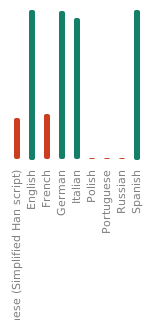
language settings. Russian and Portuguese stay out for now: at 12% and
<1% they're below the usable bar (the lowest currently-offered language,
zh-CN, sits at ~24%).

Co-Authored-By: Claude Opus 4.8 (1M context) <noreply@anthropic.com>
A Weblate translation of a <plurals> may not fill every CLDR quantity
form its locale defines — e.g. Arabic's import_reminder_prompt_body_existing
omits the "zero" form — which lint flags fatally as MissingQuantity and
aborts the CI build. The missing form falls back to "other" at runtime, so
this is the same partial-translation case we already accept for
MissingTranslation; downgrade MissingQuantity to informational alongside it.

Co-Authored-By: Claude Opus 4.8 (1M context) <noreply@anthropic.com>
Mail clients, browsers and file managers frequently label a calendar
attachment as a generic download (application/octet-stream) rather than
text/calendar, so the MIME-typed VIEW filter missed them. Add a dedicated
filter that matches those by .ics/.vcs extension via pathPattern — kept
separate so the path constraint can't narrow the reliable MIME-typed filter.
The import handler already ignores the declared MIME, so a let-through file
imports normally. Best-effort: reliable for file:// and content:// whose path
carries the name; nameless content:// URIs still fall back to the MIME filter.

Co-Authored-By: Claude Opus 4.8 (1M context) <noreply@anthropic.com>
Other apps' "Add to calendar" / "Save to calendar" actions commonly fire the
canonical insert intent — ACTION_INSERT with setType("vnd.android.cursor.item/
event") — the singular *item* MIME type (Android's own docs example; used by
e.g. DB Navigator). Calendula advertised INSERT only on the *dir* MIME type, so
it never matched: absent from the chooser, and a silent no-op when it was the
only calendar app installed.

Add the item-typed INSERT to the events filter, plus ACTION_INSERT_OR_EDIT (the
third "add to calendar" action AOSP and Google Calendar register). The runtime
parser already treats any ACTION_INSERT as create; teach insertFormOrNull /
editEventKeyOrNull about INSERT_OR_EDIT so an id-less one is a create and an
id-carrying one opens the edit form.

Co-Authored-By: Claude Opus 4.8 (1M context) <noreply@anthropic.com>
The scrolling styles navigate by scroll position and never set the paged
month, so it sat wherever paged navigation last left it — today's month
on a fresh open. Switching to a paged style, or reseeding the other
scrolling style's list state (both read off it), snapped back there
instead of holding the month on screen.

Track the paged month to the visible month while a scrolling style is
up, realigning the split selection alongside it so landing on Split
shows a live day in the month you were viewing rather than a stale,
off-month one.

Co-Authored-By: Claude Opus 4.8 (1M context) <noreply@anthropic.com>
Tapping a greyed leading/trailing day in the split grid follows the
selection to that day's own month, but selectDate never set the slide
direction — so the incoming page reused whatever the last swipe left in
slideDir and could travel backwards while navigation moved forwards.

Wrap selectDate so a tap that crosses months points slideDir at the
month it is actually heading to.

Co-Authored-By: Claude Opus 4.8 (1M context) <noreply@anthropic.com>
The chooser showed a per-style blurb on every row and a generic feature
summary under the preview. Move the selected style's own blurb under its
preview instead, drop the generic summary, and reduce the rows to a single
line — the preview is now bigger (280dp, wider) in the space that frees up.

The blurbs now stand alone: Dense's copy referenced Continuous ("the same
endless scroll…"), which made no sense once each shows in isolation. Rename
the two vertical styles to say what they do — Continuous → "Scrolling months",
Dense → "Seamless weeks".

Co-Authored-By: Claude Opus 4.8 (1M context) <noreply@anthropic.com>
The outline was the last piece with nothing to morph against, so it could
only fade in place while everything around it moved. The expanded grid
draws no outline by design — once the cells carry real event bars it is one
mark too many — which left it partnerless.

Same answer as the multi-day dots: give it an invisible stand-in over the
same cell in the expanded grid. It draws nothing and exists only to be the
other end of the morph, so the outline now rides its cell between the two
layouts.

Tagged only while it is the selected day. Tagged unconditionally it would
put a key on all 42 cells against the single partner on offer, and the
other 41 would fly in from the layout origin — the failure the dots just
had. The stand-in carries the same padding as the outline's own bounds, or
it would arrive at the wrong size, and it sits in its own layer rather than
inside the cell pill, which is itself tagged and would make it travel twice.

MonthGrid takes `selected` again, but for an anchor rather than a mark; the
other styles pass nothing and compose no extra layer at all.

Co-Authored-By: Claude Opus 4.8 (1M context) <noreply@anthropic.com>
A multi-day event has a dot on every day it covers but only one bar, so the
dots away from its start had no counterpart. Untagged they stood still and
faded; tagged without a partner they flew in from the top of the grid.
Neither is an animation — the last commit swapped one for the other.

The expanded grid now places an invisible slice of the bar in each further
column it spans, keyed to that column's day. Every dot has a real place to
come out of and go back into, at its own column, so it drops out of the bar
above it instead of appearing from nowhere.

That makes the seating's anchored flag pointless again — every dot has a
partner now — so it and its tests come back out.

Co-Authored-By: Claude Opus 4.8 (1M context) <noreply@anthropic.com>
Dots on the middle of a multi-day run flew in from the top of the grid
instead of fading where they stand.

They were meant to be left unmatched — a bar is drawn once per row, from
the column it starts in, so only that day's dot has a counterpart. But
"unmatched" was implemented as tagged-and-unmatched, which is a different
thing: a shared element entering with no partner has no bounds to start
from, so it animates in from the layout origin. The top.

Seating now says which day a bar is actually drawn from, and only that dot
carries a tag. The rest are plain content and fade in place, which is what
the comment claimed they did all along.

Co-Authored-By: Claude Opus 4.8 (1M context) <noreply@anthropic.com>
 Anonymous
 makiolaj