The flow now ends on a full screen saying so instead of dropping into the
calendar, and the notice about calendars the device is hiding is a step in
front of it rather than a dialog thrown over the app afterwards. That notice
is the one optional step an already-onboarded install can still be given, so
it is not gated on the wizard being armed; on its own it is a single screen
with no counter and no closing screen behind it.
The view and month-style steps now show their preview at the size the
Settings choosers use, at the cost of a short scroll, and the Continue
button rides at the end of the scrolling column rather than pinned over it.
The plate now spans the same width as the option rows beneath it and takes
their outer radius, so preview and options read as one stack instead of a
card floating over a list.
The steps now travel a full width on the Expressive spatial spring instead
of a fifth of one under a cross-fade, so moving through the wizard reads as
a swipe. The view previews get a tonal bezel — they draw the app's own
surface, so against a chooser drawing the same surface they had no edge of
their own — and a wider gap under them before the option rows. The frame is
shared with the Settings preview pickers so the same choice still looks the
same wherever it is made.
The default view and the month style are now a step each, and both are
built from the same live-preview-over-grouped-rows shape as the Settings
choosers they duplicate, instead of chips. The month style is asked
whatever view was picked — Month is reachable from the drawer regardless,
and making the step conditional would move the counter on the step right
before it.

Back is a button in the step's top bar and the system gesture, both
clearing the previous step's answer; the plan derives position from those
answers, so that is all the navigation there is. The calendar grant has
nothing to return to, so back stops there. The slide runs backwards when
it does.
Both steps are opaque full-screen scaffolds, so a plain cross-fade
dissolved one's text through the other's with nothing to say which way
the flow ran. Reuse the shared-axis X transition adjacent months and
weeks already use; coming off the blank first frame still just fades,
since that is the app opening rather than a step change.
The permission step said the same privacy point four times — in the body,
in two of the three benefit rows, and again in the footnote under the
button — which with the new step counter no longer fit without scrolling.
Body keeps the ask, the privacy row absorbs the tracking one, the footnote
goes, and the app-name eyebrow drops (the mark is right above it).

The reminder and backup steps share the shell and would have scrolled the
same way, so they lose their eyebrow and third row too.

Three permission strings and two reminder ones are left unused rather than
deleted: translations still carry them, and a base key a translation has is
a fatal ExtraTranslation. Weblate drops them.
The first launch becomes a counted flow. Two new steps: a backup step,
shown only when nothing you write to is synced anywhere, which picks a
folder and turns automatic backup on in one action; and a view step that
picks the default view and month style from live previews.

onboardingPlan() derives the whole flow from the stored answers, keeping
completed steps so the counter never renumbers. The optional steps only
exist for an install that went through the grant in-app, so existing
users see nothing new.

Week, Day and Agenda gain the scaled-down live preview Month already had,
sharing one viewport scaler and one set of stand-in events.
- Back now closes the drawer instead of the app: a `BackHandler` inside the sheet, enabled while the drawer is open. The four host screens (Month/Week/Day/Agenda) pass their `drawerState` in.
- Header and section labels use `GroupedListInset` instead of a hardcoded 28.dp, so "Calendula", "View" and "Calendars" share the left edge of the rows below them — same as the Settings screens. The account labels and placeholders in `CalendarFilterList` follow.
- Plain leading icons now sit in a 40.dp box, matching `CalendarColorChip`'s footprint, so view rows, jump-to-date, Settings and the calendar rows all line up on one vertical axis.
Closes#114
Co-authored-by: Jean-Luc Makiola <business@jeanlucmakiola.de>
Reviewed-on: https://codeberg.org/jlmakiola/calendula/pulls/121
CI already skips the Android build for docs-only pull requests, and that part works — a README-only PR reports green in ~11s. The skip-list was just too narrow to catch a realistic docs PR.

PR #96 is the example: a contributing guide, docs corrections and issue templates. It ran the full lint + test + assemble four times, over exactly two files Gradle never reads — `.forgejo/ISSUE_TEMPLATE/config.yml` and `.gitignore`. Added to the list: issue templates, `.planning/`, `licenses/`, `renovate.json5`, `.gitignore`, `.gitattributes`, `.editorconfig`.

It stays a skip-list rather than a build-list, so an unfamiliar path still builds by default; the workflows themselves, `.gitmodules` and `scripts/` are deliberately not skippable. The step now also prints which files forced the build, so the next "why did my docs PR build?" is answerable from the log.

One latent bug alongside it: `github.base_ref` is normalised against a `refs/heads/` prefix. Arriving in full-ref form would fail the merge-base lookup and quietly degrade the guard into "always build" — the failure mode this PR is fixing, but permanently and invisibly.

Verified by replaying the new pattern over real history: PR #96 and #97 now skip; the forge migration (workflows), the search fix (app code) and a Weblate translation merge still build.

No issue — reported directly.

Co-authored-by: Jean-Luc Makiola <business@jeanlucmakiola.de>
Reviewed-on: https://codeberg.org/jlmakiola/calendula/pulls/98
The screenshot strip linked `05-edit.png`, which doesn't exist — replaced with the real agenda screenshot, and the unused day-view shot is now shown too (six screenshots, all present).

Install is now one section per channel — official F-Droid, self-hosted F-Droid repo, Codeberg release / Obtainium, Google Play (coming soon), build from source — with an overview table up front and the previously missing "Get it on Obtainium" badge in the header. The badge links to the Codeberg releases page rather than an `obtainium://` deep link, because Forgejo's markdown sanitiser strips custom URL schemes.

The Play section notes that Play builds carry Google's signing key (so switching channels needs an uninstall) and asks for closed-testing testers.

Also corrects two stale claims: the UI is no longer German-and-English only (nine translations exist), and the language list now says so.

No issue — reported directly.

Co-authored-by: Jean-Luc Makiola <business@jeanlucmakiola.de>
Reviewed-on: https://codeberg.org/jlmakiola/calendula/pulls/97
Makes Codeberg canonical for git, issues, PRs, tags and releases. The self-hosted Gitea instance stays build infrastructure: signing key, F-Droid publishing, release pipeline.

**This PR is its own test.** It is the first PR opened on Codeberg, so a green `CI` check proves the new runner works *and* that the submodule resolves from its new home.

### 1 · floret-kit moved

Mirrored to `jlmakiola/floret-kit` (6 branches, 3 tags, every SHA verified identical) and `.gitmodules` repointed. This is what actually unblocks contributors — a clone previously could not resolve its submodule without reaching the personal Gitea instance.

The Gitea copy is **kept**: every existing tag records the old submodule URL, so rebuilds of past releases (including F-Droid reproducible rebuilds) still resolve.

### 2 · Workflows split by directory

Forgejo's lookup is first-match-wins across `.forgejo/` → `.gitea/` → `.github/`, and Gitea cannot see `.forgejo/` at all. So each forge sees exactly one set, with no duplicated files and no expression to keep in sync:

| Directory | Runs on | Contains | Secrets |
| --- | --- | --- | --- |
| `.forgejo/workflows/` | Codeberg | `ci.yaml`, `translations.yaml` | **none** |
| `.gitea/workflows/` | Gitea | `release.yaml`, `renovate.yml` | all of them |

The line is drawn at **secrets, not CI-vs-release** — that is what makes fork PRs safe. Renovate deliberately does *not* move despite opening PRs here; it keeps running where its token already lives and merely talks to Codeberg's API.

### 3 · Two release-pipeline safety changes

- `release.yaml`'s `detect` gets an explicit `repository_owner` guard. The directory split only holds while `.forgejo/` is non-empty; empty it and Codeberg would fall back to `.gitea/` and start running the release pipeline on the contributor-facing runner, without secrets.
- `detect` now reads tags from **Codeberg**, not from the Gitea instance it runs on. Push mirroring is `git push --mirror`, so a tag minted on Gitea is deleted by the next sync until the Codeberg tag push propagates back — asking Gitea inside that window reports "no tag" for an already-shipped release and would cut it twice. It also now fails on any status other than 200/404 rather than reading a transient error as "no tag": a failed job is recoverable, a duplicate release is not.

### 4 · Links repointed

In-app Source/License links, README badge, both F-Droid metadata files. **`Repo:` in `docs/fdroid-official/` deliberately stays on Gitea** — it keeps receiving `main` and every tag, so it remains a complete build source, and leaving it alone means no fdroiddata MR and no reproducible-build risk.

### Not in this PR

Renovate + Weblate repointing, and the Codeberg → Gitea push mirror (browser-side).

Supersedes Gitea PR #104.

Co-authored-by: Jean-Luc Makiola <business@jeanlucmakiola.de>
Reviewed-on: https://codeberg.org/jlmakiola/calendula/pulls/86
Adds a fourth link to the about card in settings, next to source and licence.

Play requires the privacy policy to be reachable from inside the app, not just from the store listing, for anything that touches calendar or contact data. Points at jeanlucmakiola.de/calendula/privacy.

Only the base string is added — Weblate owns the translations.

Reviewed-on: #103
Age came back `unknown` for every dependency after #98. That's the `internalChecksFilter: "none"` from that PR doing what it says on the tin — and rather more.

### Why

`lib/workers/repository/process/lookup/filter-checks.ts` short-circuits on `none`:

```js
if (internalChecksFilter === 'none') {
  release = sortedReleases.pop();     // returns here
} else {
  for (let candidateRelease of sortedReleases.reverse()) {
    ...
    const updatedCandidateRelease = await postprocessRelease(...)
```

`postprocessRelease` is the only caller that fetches a Maven artifact's `Last-Modified` header (`lib/modules/datasource/maven/index.ts:222`), so skipping the loop leaves `releaseTimestamp` unset. That empties the Age column — but it also silently voids `minimumReleaseAge` and the `renovate/stability-days` check, since both compare against that same timestamp. The cooling-off tiers were decorative.

### Fix

`flexible` keeps the intent — still prefers a version that has cleared its window, but opens the PR at the newest candidate when none has — while running the loop that populates the timestamps.

Verified with a local `--platform=local --dry-run=full`:

| dependency | new version | age |
| --- | --- | --- |
| `androidx.compose:compose-bom` | 2026.06.01 | 24 d |
| `androidx.compose.material3:material3` | 1.5.0-alpha24 | 10 d |
| `androidx.work:work-runtime-ktx` | 2.11.2 | 122 d |
| `com.android.application` (AGP) | 9.3.1 | 2 d |
| `gradle` | 9.6.1 | 29 d |

Only `ghcr.io/renovatebot/renovate` stays unknown, because the docker registry serves no timestamps at all — the run marks all 176 of its tags pending for that reason, and `flexible` is what still lets that PR through.

`Pending` rejoins the table: under a flexible filter it names the newer version being held back, rather than leaving it invisible.

### Also

Migrates the Gitea workflow manager off the deprecated `fileMatch`. Renovate's config migration was rewriting it to `managerFilePatterns` (delimited regex) on every run and warning about it; the dry run confirms the manager still picks up `.gitea/workflows` afterwards.

Validated with `renovate-config-validator` against the pinned 43.232.0.

Reviewed-on: #100
Three gaps in the Renovate setup, all about having enough in front of you at review time.

### Age reads UNKNOWN

`config:recommended` already brings in `mergeConfidence:age-confidence-badges`, so the Age column existed — it just rendered grey. Fetching the badge SVGs from `developer.mend.io` directly shows why: Mend's index covers Maven Central but has nothing for Google's Maven repo, so every androidx/compose coordinate is blank. No token changes it; the JSON API behind the badges answers 401 for everyone.

| coordinate | registry | age badge |
| --- | --- | --- |
| `androidx.compose:compose-bom` | Google Maven | UNKNOWN |
| `androidx.core:core-ktx` | Google Maven | UNKNOWN |
| `com.google.truth:truth` | Maven Central | 2y |
| `org.jetbrains.kotlin:kotlin-stdlib` | Maven Central | 1y (confidence high, passing 99%) |

Age is now computed from `newVersionAgeInDays`, which Renovate derives itself to evaluate `minimumReleaseAge` — Google Maven serves `last-modified` on its POMs, so it's populated where Mend is blank, and the number agrees with the tiers it's read against. Mend keeps the Confidence column, which still resolves for the Maven Central half (Kotlin, Gradle, AGP, the test stack).

### Empty release notes

We run against Gitea, but the packages are *released* on GitHub, so changelog lookups were going out unauthenticated against a 60/h limit. `RENOVATE_GITHUB_COM_TOKEN` lifts that.

**Needs a secret before it does anything:** a github.com PAT with **no scopes ticked**, added as repo secret `GITHUB_COM_TOKEN`. Until then the var resolves empty, which is exactly today's behaviour.

### Nothing expressed how settled a release is

Cooling-off scaled by blast radius: 30 days major, 20 minor, 10 patch/digest.

Deliberately advisory. Renovate's default `internalChecksFilter: strict` would suppress the PR outright until the version aged in; `none` opens it at the highest version immediately, so merging ahead of the window stays a decision rather than a wait. A too-young release still gets a yellow `renovate/stability-days` check — `setStability` computes that from `minimumReleaseAge` + `releaseTimestamp` independently of the filter — and with `automerge: false` nothing acts on it.

### Notes

Validated with `renovate-config-validator` against the pinned 43.232.0. Config is read from the default branch, so the open bump PRs keep their current tables until the next run after this merges.

Reviewed-on: #98
The Codeberg mirror step pushes the tag, then immediately POSTs the release
for it — but Codeberg 500s when the release request outruns its indexing of
the just-pushed ref, and with only one attempt that single 500 skipped the
mirror every release (the same POST succeeds seconds later, as a manual retry
confirmed for v2.16.0). Wrap the create/update in a backoff retry loop that
PATCHes in place if a release already exists, so a transient 5xx no longer
loses the mirror. Step stays best-effort (continue-on-error).

Co-Authored-By: Claude Opus 4.8 (1M context) <noreply@anthropic.com>
Consolidate the release under a single 2.16.0 heading dated today and fold
in the work that had accumulated in Unreleased. Add the entries the log had
been missing as PRs merged: app-name toggle (#44), the Arabic/French/Italian
translations, the custom recurrence picker redesign + end-date fix (#42),
multi-day agenda events (#83), and dark-theme picker bar icons (#70).
Regenerate the fastlane per-version changelog.

Co-Authored-By: Claude Opus 4.8 (1M context) <noreply@anthropic.com>
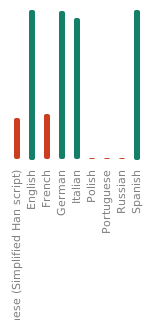
The Weblate merge added a values-ar translation (~50% complete, RTL —
the app already declares supportsRtl). Add the matching <locale> line so
Arabic is selectable in both the in-app picker and the system per-app
language settings. Russian and Portuguese stay out for now: at 12% and
<1% they're below the usable bar (the lowest currently-offered language,
zh-CN, sits at ~24%).

Co-Authored-By: Claude Opus 4.8 (1M context) <noreply@anthropic.com>