CI already skips the Android build for docs-only pull requests, and that part works — a README-only PR reports green in ~11s. The skip-list was just too narrow to catch a realistic docs PR.

PR #96 is the example: a contributing guide, docs corrections and issue templates. It ran the full lint + test + assemble four times, over exactly two files Gradle never reads — `.forgejo/ISSUE_TEMPLATE/config.yml` and `.gitignore`. Added to the list: issue templates, `.planning/`, `licenses/`, `renovate.json5`, `.gitignore`, `.gitattributes`, `.editorconfig`.

It stays a skip-list rather than a build-list, so an unfamiliar path still builds by default; the workflows themselves, `.gitmodules` and `scripts/` are deliberately not skippable. The step now also prints which files forced the build, so the next "why did my docs PR build?" is answerable from the log.

One latent bug alongside it: `github.base_ref` is normalised against a `refs/heads/` prefix. Arriving in full-ref form would fail the merge-base lookup and quietly degrade the guard into "always build" — the failure mode this PR is fixing, but permanently and invisibly.

Verified by replaying the new pattern over real history: PR #96 and #97 now skip; the forge migration (workflows), the search fix (app code) and a Weblate translation merge still build.

No issue — reported directly.

Co-authored-by: Jean-Luc Makiola <business@jeanlucmakiola.de>
Reviewed-on: https://codeberg.org/jlmakiola/calendula/pulls/98
The screenshot strip linked `05-edit.png`, which doesn't exist — replaced with the real agenda screenshot, and the unused day-view shot is now shown too (six screenshots, all present).

Install is now one section per channel — official F-Droid, self-hosted F-Droid repo, Codeberg release / Obtainium, Google Play (coming soon), build from source — with an overview table up front and the previously missing "Get it on Obtainium" badge in the header. The badge links to the Codeberg releases page rather than an `obtainium://` deep link, because Forgejo's markdown sanitiser strips custom URL schemes.

The Play section notes that Play builds carry Google's signing key (so switching channels needs an uninstall) and asks for closed-testing testers.

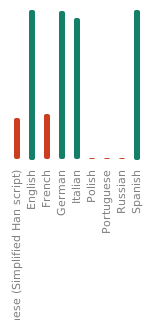
Also corrects two stale claims: the UI is no longer German-and-English only (nine translations exist), and the language list now says so.

No issue — reported directly.

Co-authored-by: Jean-Luc Makiola <business@jeanlucmakiola.de>
Reviewed-on: https://codeberg.org/jlmakiola/calendula/pulls/97
Makes Codeberg canonical for git, issues, PRs, tags and releases. The self-hosted Gitea instance stays build infrastructure: signing key, F-Droid publishing, release pipeline.

**This PR is its own test.** It is the first PR opened on Codeberg, so a green `CI` check proves the new runner works *and* that the submodule resolves from its new home.

### 1 · floret-kit moved

Mirrored to `jlmakiola/floret-kit` (6 branches, 3 tags, every SHA verified identical) and `.gitmodules` repointed. This is what actually unblocks contributors — a clone previously could not resolve its submodule without reaching the personal Gitea instance.

The Gitea copy is **kept**: every existing tag records the old submodule URL, so rebuilds of past releases (including F-Droid reproducible rebuilds) still resolve.

### 2 · Workflows split by directory

Forgejo's lookup is first-match-wins across `.forgejo/` → `.gitea/` → `.github/`, and Gitea cannot see `.forgejo/` at all. So each forge sees exactly one set, with no duplicated files and no expression to keep in sync:

| Directory | Runs on | Contains | Secrets |
| --- | --- | --- | --- |
| `.forgejo/workflows/` | Codeberg | `ci.yaml`, `translations.yaml` | **none** |
| `.gitea/workflows/` | Gitea | `release.yaml`, `renovate.yml` | all of them |

The line is drawn at **secrets, not CI-vs-release** — that is what makes fork PRs safe. Renovate deliberately does *not* move despite opening PRs here; it keeps running where its token already lives and merely talks to Codeberg's API.

### 3 · Two release-pipeline safety changes

- `release.yaml`'s `detect` gets an explicit `repository_owner` guard. The directory split only holds while `.forgejo/` is non-empty; empty it and Codeberg would fall back to `.gitea/` and start running the release pipeline on the contributor-facing runner, without secrets.
- `detect` now reads tags from **Codeberg**, not from the Gitea instance it runs on. Push mirroring is `git push --mirror`, so a tag minted on Gitea is deleted by the next sync until the Codeberg tag push propagates back — asking Gitea inside that window reports "no tag" for an already-shipped release and would cut it twice. It also now fails on any status other than 200/404 rather than reading a transient error as "no tag": a failed job is recoverable, a duplicate release is not.

### 4 · Links repointed

In-app Source/License links, README badge, both F-Droid metadata files. **`Repo:` in `docs/fdroid-official/` deliberately stays on Gitea** — it keeps receiving `main` and every tag, so it remains a complete build source, and leaving it alone means no fdroiddata MR and no reproducible-build risk.

### Not in this PR

Renovate + Weblate repointing, and the Codeberg → Gitea push mirror (browser-side).

Supersedes Gitea PR #104.

Co-authored-by: Jean-Luc Makiola <business@jeanlucmakiola.de>
Reviewed-on: https://codeberg.org/jlmakiola/calendula/pulls/86
Adds a fourth link to the about card in settings, next to source and licence.

Play requires the privacy policy to be reachable from inside the app, not just from the store listing, for anything that touches calendar or contact data. Points at jeanlucmakiola.de/calendula/privacy.

Only the base string is added — Weblate owns the translations.

Reviewed-on: #103
Age came back `unknown` for every dependency after #98. That's the `internalChecksFilter: "none"` from that PR doing what it says on the tin — and rather more.

### Why

`lib/workers/repository/process/lookup/filter-checks.ts` short-circuits on `none`:

```js
if (internalChecksFilter === 'none') {
  release = sortedReleases.pop();     // returns here
} else {
  for (let candidateRelease of sortedReleases.reverse()) {
    ...
    const updatedCandidateRelease = await postprocessRelease(...)
```

`postprocessRelease` is the only caller that fetches a Maven artifact's `Last-Modified` header (`lib/modules/datasource/maven/index.ts:222`), so skipping the loop leaves `releaseTimestamp` unset. That empties the Age column — but it also silently voids `minimumReleaseAge` and the `renovate/stability-days` check, since both compare against that same timestamp. The cooling-off tiers were decorative.

### Fix

`flexible` keeps the intent — still prefers a version that has cleared its window, but opens the PR at the newest candidate when none has — while running the loop that populates the timestamps.

Verified with a local `--platform=local --dry-run=full`:

| dependency | new version | age |
| --- | --- | --- |
| `androidx.compose:compose-bom` | 2026.06.01 | 24 d |
| `androidx.compose.material3:material3` | 1.5.0-alpha24 | 10 d |
| `androidx.work:work-runtime-ktx` | 2.11.2 | 122 d |
| `com.android.application` (AGP) | 9.3.1 | 2 d |
| `gradle` | 9.6.1 | 29 d |

Only `ghcr.io/renovatebot/renovate` stays unknown, because the docker registry serves no timestamps at all — the run marks all 176 of its tags pending for that reason, and `flexible` is what still lets that PR through.

`Pending` rejoins the table: under a flexible filter it names the newer version being held back, rather than leaving it invisible.

### Also

Migrates the Gitea workflow manager off the deprecated `fileMatch`. Renovate's config migration was rewriting it to `managerFilePatterns` (delimited regex) on every run and warning about it; the dry run confirms the manager still picks up `.gitea/workflows` afterwards.

Validated with `renovate-config-validator` against the pinned 43.232.0.

Reviewed-on: #100
Three gaps in the Renovate setup, all about having enough in front of you at review time.

### Age reads UNKNOWN

`config:recommended` already brings in `mergeConfidence:age-confidence-badges`, so the Age column existed — it just rendered grey. Fetching the badge SVGs from `developer.mend.io` directly shows why: Mend's index covers Maven Central but has nothing for Google's Maven repo, so every androidx/compose coordinate is blank. No token changes it; the JSON API behind the badges answers 401 for everyone.

| coordinate | registry | age badge |
| --- | --- | --- |
| `androidx.compose:compose-bom` | Google Maven | UNKNOWN |
| `androidx.core:core-ktx` | Google Maven | UNKNOWN |
| `com.google.truth:truth` | Maven Central | 2y |
| `org.jetbrains.kotlin:kotlin-stdlib` | Maven Central | 1y (confidence high, passing 99%) |

Age is now computed from `newVersionAgeInDays`, which Renovate derives itself to evaluate `minimumReleaseAge` — Google Maven serves `last-modified` on its POMs, so it's populated where Mend is blank, and the number agrees with the tiers it's read against. Mend keeps the Confidence column, which still resolves for the Maven Central half (Kotlin, Gradle, AGP, the test stack).

### Empty release notes

We run against Gitea, but the packages are *released* on GitHub, so changelog lookups were going out unauthenticated against a 60/h limit. `RENOVATE_GITHUB_COM_TOKEN` lifts that.

**Needs a secret before it does anything:** a github.com PAT with **no scopes ticked**, added as repo secret `GITHUB_COM_TOKEN`. Until then the var resolves empty, which is exactly today's behaviour.

### Nothing expressed how settled a release is

Cooling-off scaled by blast radius: 30 days major, 20 minor, 10 patch/digest.

Deliberately advisory. Renovate's default `internalChecksFilter: strict` would suppress the PR outright until the version aged in; `none` opens it at the highest version immediately, so merging ahead of the window stays a decision rather than a wait. A too-young release still gets a yellow `renovate/stability-days` check — `setStability` computes that from `minimumReleaseAge` + `releaseTimestamp` independently of the filter — and with `automerge: false` nothing acts on it.

### Notes

Validated with `renovate-config-validator` against the pinned 43.232.0. Config is read from the default branch, so the open bump PRs keep their current tables until the next run after this merges.

Reviewed-on: #98
The Codeberg mirror step pushes the tag, then immediately POSTs the release
for it — but Codeberg 500s when the release request outruns its indexing of
the just-pushed ref, and with only one attempt that single 500 skipped the
mirror every release (the same POST succeeds seconds later, as a manual retry
confirmed for v2.16.0). Wrap the create/update in a backoff retry loop that
PATCHes in place if a release already exists, so a transient 5xx no longer
loses the mirror. Step stays best-effort (continue-on-error).

Co-Authored-By: Claude Opus 4.8 (1M context) <noreply@anthropic.com>
Consolidate the release under a single 2.16.0 heading dated today and fold
in the work that had accumulated in Unreleased. Add the entries the log had
been missing as PRs merged: app-name toggle (#44), the Arabic/French/Italian
translations, the custom recurrence picker redesign + end-date fix (#42),
multi-day agenda events (#83), and dark-theme picker bar icons (#70).
Regenerate the fastlane per-version changelog.

Co-Authored-By: Claude Opus 4.8 (1M context) <noreply@anthropic.com>
The Weblate merge added a values-ar translation (~50% complete, RTL —
the app already declares supportsRtl). Add the matching <locale> line so
Arabic is selectable in both the in-app picker and the system per-app
language settings. Russian and Portuguese stay out for now: at 12% and
<1% they're below the usable bar (the lowest currently-offered language,
zh-CN, sits at ~24%).

Co-Authored-By: Claude Opus 4.8 (1M context) <noreply@anthropic.com>
A Weblate translation of a <plurals> may not fill every CLDR quantity
form its locale defines — e.g. Arabic's import_reminder_prompt_body_existing
omits the "zero" form — which lint flags fatally as MissingQuantity and
aborts the CI build. The missing form falls back to "other" at runtime, so
this is the same partial-translation case we already accept for
MissingTranslation; downgrade MissingQuantity to informational alongside it.

Co-Authored-By: Claude Opus 4.8 (1M context) <noreply@anthropic.com>
Mail clients, browsers and file managers frequently label a calendar
attachment as a generic download (application/octet-stream) rather than
text/calendar, so the MIME-typed VIEW filter missed them. Add a dedicated
filter that matches those by .ics/.vcs extension via pathPattern — kept
separate so the path constraint can't narrow the reliable MIME-typed filter.
The import handler already ignores the declared MIME, so a let-through file
imports normally. Best-effort: reliable for file:// and content:// whose path
carries the name; nameless content:// URIs still fall back to the MIME filter.

Co-Authored-By: Claude Opus 4.8 (1M context) <noreply@anthropic.com>
Other apps' "Add to calendar" / "Save to calendar" actions commonly fire the
canonical insert intent — ACTION_INSERT with setType("vnd.android.cursor.item/
event") — the singular *item* MIME type (Android's own docs example; used by
e.g. DB Navigator). Calendula advertised INSERT only on the *dir* MIME type, so
it never matched: absent from the chooser, and a silent no-op when it was the
only calendar app installed.

Add the item-typed INSERT to the events filter, plus ACTION_INSERT_OR_EDIT (the
third "add to calendar" action AOSP and Google Calendar register). The runtime
parser already treats any ACTION_INSERT as create; teach insertFormOrNull /
editEventKeyOrNull about INSERT_OR_EDIT so an id-less one is a create and an
id-carrying one opens the edit form.

Co-Authored-By: Claude Opus 4.8 (1M context) <noreply@anthropic.com>
floret-kit#3 merged to main; move the pointer from the fix branch commit
to the main merge commit. No code change — same tree.

Co-Authored-By: Claude Opus 4.8 (1M context) <noreply@anthropic.com>
Bump floret-kit to the fix that drives each picker Dialog window's
status/navigation-bar icon appearance from the runtime theme. The picker
Dialog owns its own Window, seeded from the XML theme rather than the
activity's runtime edge-to-edge state, so in dark theme the status-bar
icons went black and near-invisible on the dark picker (Codeberg #70).

Co-Authored-By: Claude Opus 4.8 (1M context) <noreply@anthropic.com>
The scrolling styles navigate by scroll position and never set the paged
month, so it sat wherever paged navigation last left it — today's month
on a fresh open. Switching to a paged style, or reseeding the other
scrolling style's list state (both read off it), snapped back there
instead of holding the month on screen.

Track the paged month to the visible month while a scrolling style is
up, realigning the split selection alongside it so landing on Split
shows a live day in the month you were viewing rather than a stale,
off-month one.

Co-Authored-By: Claude Opus 4.8 (1M context) <noreply@anthropic.com>
Tapping a greyed leading/trailing day in the split grid follows the
selection to that day's own month, but selectDate never set the slide
direction — so the incoming page reused whatever the last swipe left in
slideDir and could travel backwards while navigation moved forwards.

Wrap selectDate so a tap that crosses months points slideDir at the
month it is actually heading to.

Co-Authored-By: Claude Opus 4.8 (1M context) <noreply@anthropic.com>
The chooser showed a per-style blurb on every row and a generic feature
summary under the preview. Move the selected style's own blurb under its
preview instead, drop the generic summary, and reduce the rows to a single
line — the preview is now bigger (280dp, wider) in the space that frees up.

The blurbs now stand alone: Dense's copy referenced Continuous ("the same
endless scroll…"), which made no sense once each shows in isolation. Rename
the two vertical styles to say what they do — Continuous → "Scrolling months",
Dense → "Seamless weeks".

Co-Authored-By: Claude Opus 4.8 (1M context) <noreply@anthropic.com>
The outline was the last piece with nothing to morph against, so it could
only fade in place while everything around it moved. The expanded grid
draws no outline by design — once the cells carry real event bars it is one
mark too many — which left it partnerless.

Same answer as the multi-day dots: give it an invisible stand-in over the
same cell in the expanded grid. It draws nothing and exists only to be the
other end of the morph, so the outline now rides its cell between the two
layouts.

Tagged only while it is the selected day. Tagged unconditionally it would
put a key on all 42 cells against the single partner on offer, and the
other 41 would fly in from the layout origin — the failure the dots just
had. The stand-in carries the same padding as the outline's own bounds, or
it would arrive at the wrong size, and it sits in its own layer rather than
inside the cell pill, which is itself tagged and would make it travel twice.

MonthGrid takes `selected` again, but for an anchor rather than a mark; the
other styles pass nothing and compose no extra layer at all.

Co-Authored-By: Claude Opus 4.8 (1M context) <noreply@anthropic.com>
A multi-day event has a dot on every day it covers but only one bar, so the
dots away from its start had no counterpart. Untagged they stood still and
faded; tagged without a partner they flew in from the top of the grid.
Neither is an animation — the last commit swapped one for the other.

The expanded grid now places an invisible slice of the bar in each further
column it spans, keyed to that column's day. Every dot has a real place to
come out of and go back into, at its own column, so it drops out of the bar
above it instead of appearing from nowhere.

That makes the seating's anchored flag pointless again — every dot has a
partner now — so it and its tests come back out.

Co-Authored-By: Claude Opus 4.8 (1M context) <noreply@anthropic.com>
Dots on the middle of a multi-day run flew in from the top of the grid
instead of fading where they stand.

They were meant to be left unmatched — a bar is drawn once per row, from
the column it starts in, so only that day's dot has a counterpart. But
"unmatched" was implemented as tagged-and-unmatched, which is a different
thing: a shared element entering with no partner has no bounds to start
from, so it animates in from the layout origin. The top.

Seating now says which day a bar is actually drawn from, and only that dot
carries a tag. The rest are plain content and fade in place, which is what
the comment claimed they did all along.

Co-Authored-By: Claude Opus 4.8 (1M context) <noreply@anthropic.com>
Frame-by-frame, the marks were not fading in late — they were invisible
for the first half of their journey and then appearing already near the
destination, row by row from the top down.

A mark's two homes are in different rows: the dot for the 20th sits a third
of the way down the compact grid, its bar most of the way down the expanded
one. The events box clips to its own row, so a mark arriving there is out
of bounds — and undrawn — until it crosses in. The lower the row, the
further it travels and the later it showed, which is exactly the order the
capture shows them appearing in.

Rendering in place rather than in an overlay is what subjects marks to that
clip, and that is worth keeping — it is what puts the whole grid in one
z-order. So the clip yields instead, and only while pieces are in flight;
at rest it still stops a bar spilling into the row below.

Co-Authored-By: Claude Opus 4.8 (1M context) <noreply@anthropic.com>
Travelling pieces were painted into an overlay above the entire tree —
Compose's default, and right for a thumbnail flying across a screen, wrong
for a grid changing shape in place. Everything tagged left the tree's
z-order, so every untagged neighbour spent the transition buried under it.

Lifting each of those out in turn — the selection outline, then both "+N"
markers — fixed the burying and bought something worse: they floated over
the grid on a layer of their own, out of step with what they belong to.
Three pieces needing the same escape hatch was the tell that the overlay
itself was wrong here.

Nothing renders in the overlay now. One z-order, one clip, so the grid
reads as a single surface changing shape rather than a stack of pieces
sliding past each other. The outline goes back to being plain content that
sits above its own pill the ordinary way, and morphOverlay is gone.

The "+N" markers become a matched pair instead of an orphan. The compact
grid writes the count as text and the expanded one as a row of dots, but
they stand for the same events on exactly the same days — both seat three
and overflow the rest — so they were always two halves of one marker.

Co-Authored-By: Claude Opus 4.8 (1M context) <noreply@anthropic.com>
Two reasons a mark arrived a beat late instead of animating.

The dots and bars carried morphBounds *inside* their own size modifiers, so
the shared bounds had nothing to drive: the dot stayed pinned at 5dp however
far its bar had travelled, and the bar sat at full width from the first
frame, each snapping into place only once the transition ended. The growth
was being clamped away. morphBounds now sits outside the width/height on
both sides. A bar's offset stays outside it — that is where the bar sits,
not how big it is.

The "+N" overflow markers were untagged, so they spent every transition
painted over by the overlay the tagged pieces draw into, exactly as the
selection outline did. Both the compact grid's and the expanded grid's are
now lifted into it.

The outline itself moves to the fast effects spec, as asked: it is a small
mark that only ever appears or disappears, and at the shared pace it
lingered after the thing it marks had already moved.

Co-Authored-By: Claude Opus 4.8 (1M context) <noreply@anthropic.com>
Sending the outline to the shared-transition overlay stopped it hiding
behind its own cell, but it also lifted it out of the layer AnimatedContent
fades the outgoing page with — so it stopped fading at all. It stood at
full strength for the whole expand or collapse and then blinked out at the
end, which is the opposite half of the same bug.

The fade is reapplied on the lifted content's own layer, so it travels with
it. That belongs in morphOverlay rather than at the call site: anything
sent to the overlay loses the parent's fade the same way.

Co-Authored-By: Claude Opus 4.8 (1M context) <noreply@anthropic.com>
The handle advertised a gesture it didn't answer to — the drag lived on the
grid alone, so the one part of the screen that says "pull me" was the one
part that ignored being pulled. Grid and handle now drag as a single
surface; the pane stays outside it, since it scrolls and is full of
tappable rows. Tapping the handle still toggles: a parent drag and a child
clickable coexist the same way they do in any scrollable list.

The selection outline was still flickering through an expand or collapse,
and being untagged was not enough to explain it. Tagged pieces paint into
an overlay above the whole regular tree, so the outline — correctly left in
that tree, to keep the collapsed cell's bounds — spent every transition
hidden behind its own morphing pill and reappeared the moment it ended.
It now renders into that same overlay while keeping its own bounds, which
is what the untagged layout was for in the first place.

Co-Authored-By: Claude Opus 4.8 (1M context) <noreply@anthropic.com>
The split style's pull-to-expand fires the moment the drag clears its
threshold, and that turned out to be the better feel — so paging now does
the same everywhere: month, week and day.

Waiting for the lift meant the page sat still under a finger that had
already travelled far enough to ask for it, and the answer only arrived
once you let go, which reads as the view being slow rather than as a
deliberate commit. The trade is that a drag can no longer be taken back by
dragging the other way; once you have moved 24dp deliberately you meant it,
and the page you left is one swipe back.

The three views had three copies of the same detector, so this extracts one
rememberCalendarPageSwipe and the threshold constant beside it. It stays
horizontal-only on purpose: the week and day timelines scroll vertically
underneath, and a two-dimensional detector would claim those drags before
the inner scroll saw them. The month keeps its own axis-locking detector
because the split style needs the vertical axis, and now shares the
threshold.

Also fixes the selection outline shivering rather than fading. Its animated
alpha was read while composing the cell, so every frame of the fade
recomposed all 42 cells at once — the fade was driving the whole grid
through recomposition to change one colour. It is now held as a State and
read inside a drawBehind, which keeps it in the draw phase where it touches
nothing but pixels. That means drawing the rounded rect by hand instead of
Modifier.border, so the corner radius is named alongside CELL_SHAPE to stop
the two drifting.

Co-Authored-By: Claude Opus 4.8 (1M context) <noreply@anthropic.com>
Drawn on the cell's morphing pill, the outline rode its shared bounds — so
collapsing painted it at the *expanded* cell's size and shrank it down, a
full-height outline flashing over a grid that no longer had full-height
cells. The same shape of mistake as the marker that used to cross the
outgoing month during a page turn.

It gets its own untagged layer, laid out where the collapsed cell actually
is, and fades in there. That is the only size it is ever true at.

Co-Authored-By: Claude Opus 4.8 (1M context) <noreply@anthropic.com>
The trigger was what felt slow, and firing on the threshold instead of on
release already fixed that. Speeding up the animation on top of it was a
second change to the same complaint, and not one that was asked for — the
morph goes back to the shared calendar slide and fade specs, so it moves at
the same pace as every other transition in the app.

Co-Authored-By: Claude Opus 4.8 (1M context) <noreply@anthropic.com>
Three things from the first on-device look.

The selection outline is gone from the expanded grid. Once the cells carry
real event bars it was one mark too many, and it had nothing to say —
every day there is one tap from being selected, and tapping is what closes
the view. MonthGrid/MonthWeekRow lose the parameter again.

Expand and collapse now fire the instant the drag clears the threshold
instead of on release. Waiting for the lift left the screen inert under a
finger that had already asked for the thing, which read as the gesture
being slow to take rather than as a deliberate commit. Paging still waits,
because there the gesture is genuinely undecided until you let go — you can
drag back and settle on a different month. Between expanded and collapsed
there is nothing to change your mind about.

The morph itself runs on the motion scheme's *fast* specs rather than the
page slide's default ones. Paging is a spring under one whole page and
wants room to settle; this answers a drag already committed to, and with a
hundred-odd pieces moving at once a long settle reads as lag.

Co-Authored-By: Claude Opus 4.8 (1M context) <noreply@anthropic.com>
Expanding replaces the whole screen, so it is a place you can be, and every
other place in the app can be backed out of. Without this, back left the
Month view entirely and coming back found it still expanded.

Declared deeper than CalendarHost's view-stack handler, which is what makes
it take precedence while it is enabled.

Co-Authored-By: Claude Opus 4.8 (1M context) <noreply@anthropic.com>
The expand cross-faded two unrelated grids, so a day's cell jumped from a
46dp row near the top of the screen to a full-height one halfway down and
the dots simply vanished where bars appeared. It read as a swap, not as the
month opening up.

Tag the pieces that mean the same thing on both sides and let Compose carry
them: each cell pill grows, its number rides along, and every dot travels
out to the bar it stood for — which only works because the dots are now
seated by lane, so each one has exactly one bar to become.

The tags travel as a composition local with a null default, so the paged,
continuous, and dense styles — which share these same row and cell
composables — provide nothing and pay nothing. Reduced motion provides
nothing either, leaving the plain cross-fade underneath.

A multi-day bar is anchored on the day it starts in its row; the dots on
the days it merely covers are left unmatched and fade where they stand
while the bar sweeps out over them. Only one of them could become the bar
without the others teleporting into it.

Co-Authored-By: Claude Opus 4.8 (1M context) <noreply@anthropic.com>
Drag the compact grid down and the day pane gives way to the month drawn
the paged style's way — real bars and pills, not dots; drag up to bring the
pane back. Split could show you which days were busy, or one day in full,
but never the month's events at once without a trip to Settings.

The month swipe grows a second axis to do it, so the two are locked to one
decision per gesture: independent horizontal and vertical detectors would
each see their own component of a diagonal drag and both fire. Paging keeps
ties, so an ambiguous drag still reads as it did.

A tap in the expanded grid picks the day and drops back, which makes it a
chooser you dip into rather than a mode you can get stranded in — so the
grid needs the selection outline too, which MonthGrid now takes optionally.

Expansion is state, not a preference: persisted, someone would expand it
once and later find their Split style changed with nothing to explain why.

Co-Authored-By: Claude Opus 4.8 (1M context) <noreply@anthropic.com>

 Jean-Luc Makiolaandmakiolaj