Makes Codeberg canonical for git, issues, PRs, tags and releases. The self-hosted Gitea instance stays build infrastructure: signing key, F-Droid publishing, release pipeline.

**This PR is its own test.** It is the first PR opened on Codeberg, so a green `CI` check proves the new runner works *and* that the submodule resolves from its new home.

### 1 · floret-kit moved

Mirrored to `jlmakiola/floret-kit` (6 branches, 3 tags, every SHA verified identical) and `.gitmodules` repointed. This is what actually unblocks contributors — a clone previously could not resolve its submodule without reaching the personal Gitea instance.

The Gitea copy is **kept**: every existing tag records the old submodule URL, so rebuilds of past releases (including F-Droid reproducible rebuilds) still resolve.

### 2 · Workflows split by directory

Forgejo's lookup is first-match-wins across `.forgejo/` → `.gitea/` → `.github/`, and Gitea cannot see `.forgejo/` at all. So each forge sees exactly one set, with no duplicated files and no expression to keep in sync:

| Directory | Runs on | Contains | Secrets |
| --- | --- | --- | --- |
| `.forgejo/workflows/` | Codeberg | `ci.yaml`, `translations.yaml` | **none** |
| `.gitea/workflows/` | Gitea | `release.yaml`, `renovate.yml` | all of them |

The line is drawn at **secrets, not CI-vs-release** — that is what makes fork PRs safe. Renovate deliberately does *not* move despite opening PRs here; it keeps running where its token already lives and merely talks to Codeberg's API.

### 3 · Two release-pipeline safety changes

- `release.yaml`'s `detect` gets an explicit `repository_owner` guard. The directory split only holds while `.forgejo/` is non-empty; empty it and Codeberg would fall back to `.gitea/` and start running the release pipeline on the contributor-facing runner, without secrets.
- `detect` now reads tags from **Codeberg**, not from the Gitea instance it runs on. Push mirroring is `git push --mirror`, so a tag minted on Gitea is deleted by the next sync until the Codeberg tag push propagates back — asking Gitea inside that window reports "no tag" for an already-shipped release and would cut it twice. It also now fails on any status other than 200/404 rather than reading a transient error as "no tag": a failed job is recoverable, a duplicate release is not.

### 4 · Links repointed

In-app Source/License links, README badge, both F-Droid metadata files. **`Repo:` in `docs/fdroid-official/` deliberately stays on Gitea** — it keeps receiving `main` and every tag, so it remains a complete build source, and leaving it alone means no fdroiddata MR and no reproducible-build risk.

### Not in this PR

Renovate + Weblate repointing, and the Codeberg → Gitea push mirror (browser-side).

Supersedes Gitea PR #104.

Co-authored-by: Jean-Luc Makiola <business@jeanlucmakiola.de>
Reviewed-on: https://codeberg.org/jlmakiola/calendula/pulls/86
Adds a fourth link to the about card in settings, next to source and licence.

Play requires the privacy policy to be reachable from inside the app, not just from the store listing, for anything that touches calendar or contact data. Points at jeanlucmakiola.de/calendula/privacy.

Only the base string is added — Weblate owns the translations.

Reviewed-on: #103
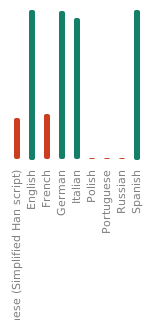
The Weblate merge added a values-ar translation (~50% complete, RTL —
the app already declares supportsRtl). Add the matching <locale> line so
Arabic is selectable in both the in-app picker and the system per-app
language settings. Russian and Portuguese stay out for now: at 12% and
<1% they're below the usable bar (the lowest currently-offered language,
zh-CN, sits at ~24%).

Co-Authored-By: Claude Opus 4.8 (1M context) <noreply@anthropic.com>
The chooser showed a per-style blurb on every row and a generic feature
summary under the preview. Move the selected style's own blurb under its
preview instead, drop the generic summary, and reduce the rows to a single
line — the preview is now bigger (280dp, wider) in the space that frees up.

The blurbs now stand alone: Dense's copy referenced Continuous ("the same
endless scroll…"), which made no sense once each shows in isolation. Rename
the two vertical styles to say what they do — Continuous → "Scrolling months",
Dense → "Seamless weeks".

Co-Authored-By: Claude Opus 4.8 (1M context) <noreply@anthropic.com>
Drag the compact grid down and the day pane gives way to the month drawn
the paged style's way — real bars and pills, not dots; drag up to bring the
pane back. Split could show you which days were busy, or one day in full,
but never the month's events at once without a trip to Settings.

The month swipe grows a second axis to do it, so the two are locked to one
decision per gesture: independent horizontal and vertical detectors would
each see their own component of a diagonal drag and both fire. Paging keeps
ties, so an ambiguous drag still reads as it did.

A tap in the expanded grid picks the day and drops back, which makes it a
chooser you dip into rather than a mode you can get stranded in — so the
grid needs the selection outline too, which MonthGrid now takes optionally.

Expansion is state, not a preference: persisted, someone would expand it
once and later find their Split style changed with nothing to explain why.

Co-Authored-By: Claude Opus 4.8 (1M context) <noreply@anthropic.com>
Continuous's month blocks make the boundaries legible, but the seams are exactly
what someone who wants a dense calendar doesn't want. Both are now offered:

- **Dense** is the old flowing layout, kept rather than replaced — one
  uninterrupted stream of weeks with months running into each other, the 1st
  naming its month, and the top bar keeping the full month title (there is no
  sticky header to defer to).
- Continuous gains a **rule under its month label**, closing the header off
  against the grid. On trial: it comes out again if it doesn't earn its place.

One provider query serves both. `ContinuousMonthUiState.Success` now carries the
same loaded window laid out twice — `monthsByIndex` clipped into blocks,
`weeksByIndex` left whole — rather than standing up a second flow and querying
the same range again. Both styles report *months* as they scroll, so the window
hysteresis is shared; `weekWindowFor` maps a month window onto the Dense rows it
covers, widened a week each side so boundary rows don't flicker.

The list state is keyed on style *and* week start: Dense indexes by week, which
the week-start preference moves, while Continuous indexes by month, which it
doesn't — carrying an offset between the two would land somewhere arbitrary.

Co-Authored-By: Claude Opus 4.8 (1M context) <noreply@anthropic.com>
The continuous style streamed weeks with no boundaries at all, which left it
hard to tell where one month ended: the only marker was a "Jul 1" label on the
1st, and every boundary week mixed two months' days into one row.

It is now a vertical stack of self-contained month blocks. Each block shows only
its own days — the boundary week keeps its seven columns so nothing shifts
sideways, but the neighbour month's cells are blank rather than filled with
duplicates of days shown again a block later — under a sticky month header with
whitespace either side. Scrolling stays continuous; only the reading changes.

- The coordinate space moves from absolute week index to absolute month index
  (two LazyColumn items per month: header, then block). Unlike week indices, it
  doesn't depend on the week-start preference, so changing that reflows the rows
  inside a block without moving the block or losing the scroll position.
- The sliding data window now loads months rather than weeks, widened to whole
  grid weeks at both ends so a bar reaching into a block from a clipped-off day
  still renders.
- `clipWeekToMonth` is the pure seam: it drops the neighbour month's pills and
  counts and cuts spanning bars back to the month's own columns, keeping a flat
  cap on the cut side so a bar reads as continuing past the block.
- The top bar carries the year in this style — the block's own header names the
  month, so repeating it two lines up was pure duplication.

Co-Authored-By: Claude Opus 4.8 (1M context) <noreply@anthropic.com>
Introduces MonthViewStyle{Paged, Continuous, Split} and the setting that
chooses it. Only Paged is wired up so far — the other two land next; this
commit is the pref, the state plumbing and the chooser.

One picker rather than two switches ("vertical scrolling" + "month with
agenda"): independent toggles would multiply into four combinations, most of
which nobody asked for. Split does not disable the Agenda view — that stays a
forward multi-day window, while the split pane lists one selected day.

The chooser lives on the Views settings screen (per-view layout belongs with
the other view configuration) and is a hand-rolled FullScreenPicker rather than
OptionPicker, which cannot render previews: the three options differ in shape,
which a word like "Continuous" does not convey. Each card carries a schematic
drawn from theme tokens, and selection reads three ways over — border weight,
container tint and a check — so it never rests on colour alone. The cards are a
selectableGroup with Role.RadioButton for screen readers.

Folded into the ViewCustomization holder, which had spare arity; the outer
settings combine is still at its five-flow limit.

Co-Authored-By: Claude Opus 4.8 (1M context) <noreply@anthropic.com>
Review follow-ups to the picker redesign, plus the bugs it exposed.

The live read-out now renders customResult itself — the exact string OK
would save — instead of rebuilding a parallel rule with `interval ?: 1`
and `end ?: Never` fallbacks, which let it confidently describe a rule
that differed from the selected controls whenever a field was invalid.

Shrink the invalid space behind it: a blank amount field reads as its
visible placeholder (1 / 10) rather than as an error, and backing out of
the date picker falls back to "never" instead of stranding a dateless
"on a date". Only an out-of-range 0 remains invalid, and that now says so
rather than greying out OK with no cause.

UNTIL displayed the day after the one picked for zones behind UTC:
toRRule deliberately writes the end of the chosen *local* day expressed
in UTC (the provider applies UNTIL coarsely), so the read side must
convert back before taking the date. Fixes the detail screen too, and
untilLocalDate is extracted so it can be tested.

Also: hoist a remember() out of a conditional (a slot that appears and
disappears breaks positional memoisation), match GroupedSurface's 22dp
corners instead of a drifted local 20dp copy, move the cards onto
GroupedSurface, drop the segmented row's icon slot so longer unit labels
fit, and reserve two lines so the stack stops shifting as the phrase
grows with each weekday.

Extract SettingsPrefs.firstDayOfWeek(scope), replacing three copies that
had drifted onto different initialValues.

Co-Authored-By: Claude Opus 4.8 (1M context) <noreply@anthropic.com>
Correctness:
- Recurring writes: move the series DTSTART by the *wall-clock* shift applied
  to the edited occurrence and re-resolve it in the event's zone, instead of by
  a millisecond delta. The old delta baked in whichever UTC offset applied on
  the edited occurrence's date, so pinning a recurring event to another zone —
  or editing an occurrence on the far side of a DST boundary from the series
  anchor — shifted the whole series by an hour. Also snaps the anchor to a UTC
  midnight when the event becomes all-day.
- Detail card and edit form now resolve a pinned zone's abbreviation/offset at
  the *event's* instant, not at "now", so a July event no longer reads
  "CET · 10:00 AM" when opened in January.
- Agenda: the zone used to label multi-day rows now travels on
  AgendaUiState.Success rather than a process-lifetime file-level constant, so
  labelling can't disagree with the grouping after a device time-zone change.
- Week title: spell out the year when the week straddles New Year, via a new
  forceYear flag on formatCalendarTitle.

Performance:
- Build the ~600-entry zone catalogue off the main thread (produceState +
  Dispatchers.Default); resolve the device row's summary on its own so it still
  renders complete on the first frame.
- Pre-normalize each TimeZoneOption's search keys at construction, turning
  ~2400 NFD normalizations per keystroke into plain prefix/substring checks.
  Hoist the combining-mark Regex out of the hot path.
- Key the edit form's local-time line on the fields it reads instead of
  recomputing it on every keystroke.
- Move LauncherNameManager's PackageManager binder calls off the main thread.

Cleanup:
- Drop a duplicate Public icon import and the unused
  event_edit_timezone_clear string.

Co-Authored-By: Claude Opus 4.8 (1M context) <noreply@anthropic.com>
Add a Settings → Appearance toggle that switches the app's launcher label
between "Calendula" and "Calendar", for users on launchers that can't rename
apps themselves.

The launcher entry moves off MainActivity onto two <activity-alias> components
(DefaultNameAlias / CalendarNameAlias); exactly one is enabled at a time via
PackageManager.setComponentEnabledSetting. MainActivity keeps every other intent
filter; the android.app.shortcuts meta-data moves onto both aliases so the
long-press shortcut still publishes. Component-enabled state is the single source
of truth — no persisted preference.

The ComponentName uses the applicationId for the package (carrying the
.debug/.releasetest suffix) and the namespace for the class, since manifest
".Alias" names resolve against the namespace; switching to Calendar enables the
target alias before disabling the other to avoid a zero-entry launcher transient.

Co-Authored-By: Claude Opus 4.8 (1M context) <noreply@anthropic.com>
Add a "Today button in toolbar" appearance toggle (default off). When on,
each calendar view (month/week/day/agenda) shows a persistent go-to-today
icon button in its top bar instead of the fade-in extended FAB, and the
FAB pill is suppressed. Same jump action, just always present.

Co-Authored-By: Claude Opus 4.8 (1M context) <noreply@anthropic.com>
The "→" arrow convention read as unclear. Spell each day out instead:
the first day names the start ("Starts 14:00"), the last day the end
("Ends 10:00"), and whole days in between read as "All day". All-day
multi-day events stay "All day" on every day. Single-day rows unchanged.

Adds agenda_span_starts / agenda_span_ends (owes Weblate backfill).

Co-Authored-By: Claude Opus 4.8 (1M context) <noreply@anthropic.com>
The When card reads date-large, time-small-beneath. The zone card led
with the original time at titleMedium and dropped the zone label to
bodyMedium, inverting that — which made the foreign time the loudest
thing on the screen and pulled attention off the local time the reader
actually acts on.

Put the label back on top and the original time small beneath it, so both
cards read the same way and the original stays available without
competing. The label already names the zone, so the range drops its "in
New York" tail (and the string with it).

Co-Authored-By: Claude Opus 4.8 (1M context) <noreply@anthropic.com>